
A Mitzvah in Motion: From a Pair of Shoes to a Place to Call Home
Not long ago, a simple act of kindness, a mitzvah, set something powerful in motion.
It began with Elliott Levin, a retired Indianapolis attorney and founder of Rubin & Levin, who donated three pairs of size 17 shoes to RecycleForce. At the time, it seemed like a small gesture, passing along something he no longer needed. But those shoes found their way to someone who did.
Mr. Brewer, a RecycleForce participant working to rebuild his life after incarceration, had long struggled to find shoes that fit. When he slipped them on, it was more than a physical fit, it was a moment of dignity, of being seen, of being supported in a world that often makes starting over feel impossible.
But as meaningful as that moment was, it was only the beginning.
Mr. Brewer wasn’t just looking for shoes, he was searching for stability. The journey back after incarceration hasn’t been easy. Like so many returning citizens, he faced one of the most common, and most discouraging, barriers to rebuilding his life: finding stable housing. Despite having the desire to work, to reconnect with his wife, and to move forward, doors remained closed. He was looking for a chance to live with his wife again…for a place to call home.
“It’s hard finding a house with my wife,” he shared. “It’s hard to find a landlord who will rent to me.”
A Deeper meaning Behind the Mitzvah
In Jewish tradition, a mitzvah is more than a good deed; it is an act rooted in justice, responsibility, and the belief that people are capable of transformation. For Greg Maurer, Chairman of The National Bank of Indianapolis, that belief is central to how we should view returning citizens.
“Judaism has always taught that no human being is defined by their worst moment,” Maurer shared. “The concept of teshuvah—repentance, or literally ‘return’—sits at the very center of Jewish ethics.”
But teshuvah is not just about forgiveness, it’s about transformation.
“The idea is not merely that wrongdoing can be forgiven,” he explained, “but that the act of genuine return actually transforms who a person is. The Talmud goes so far as to say that one who has truly returned has achieved a status level that even the perfectly righteous cannot reach.”
That belief doesn’t live in theory, it requires action.
“Work also helps with redemption,” Maurer said. “The sages understood work not merely as economic necessity but as spiritually rehabilitative. The act of labor restores a person's sense of dignity, agency, and contribution to the world.”
In that way, the work happening every day at RecycleForce is not just job training, it is a pathway to restoration.
When Community Becomes the Bridge
This story reflects a deeper, long-standing connection between communities. Acts like this have often brought the Jewish and Black communities together in shared purpose. One offering a framework of responsibility and repair, the other carrying lived experience of resilience and perseverance in the face of systemic barriers.
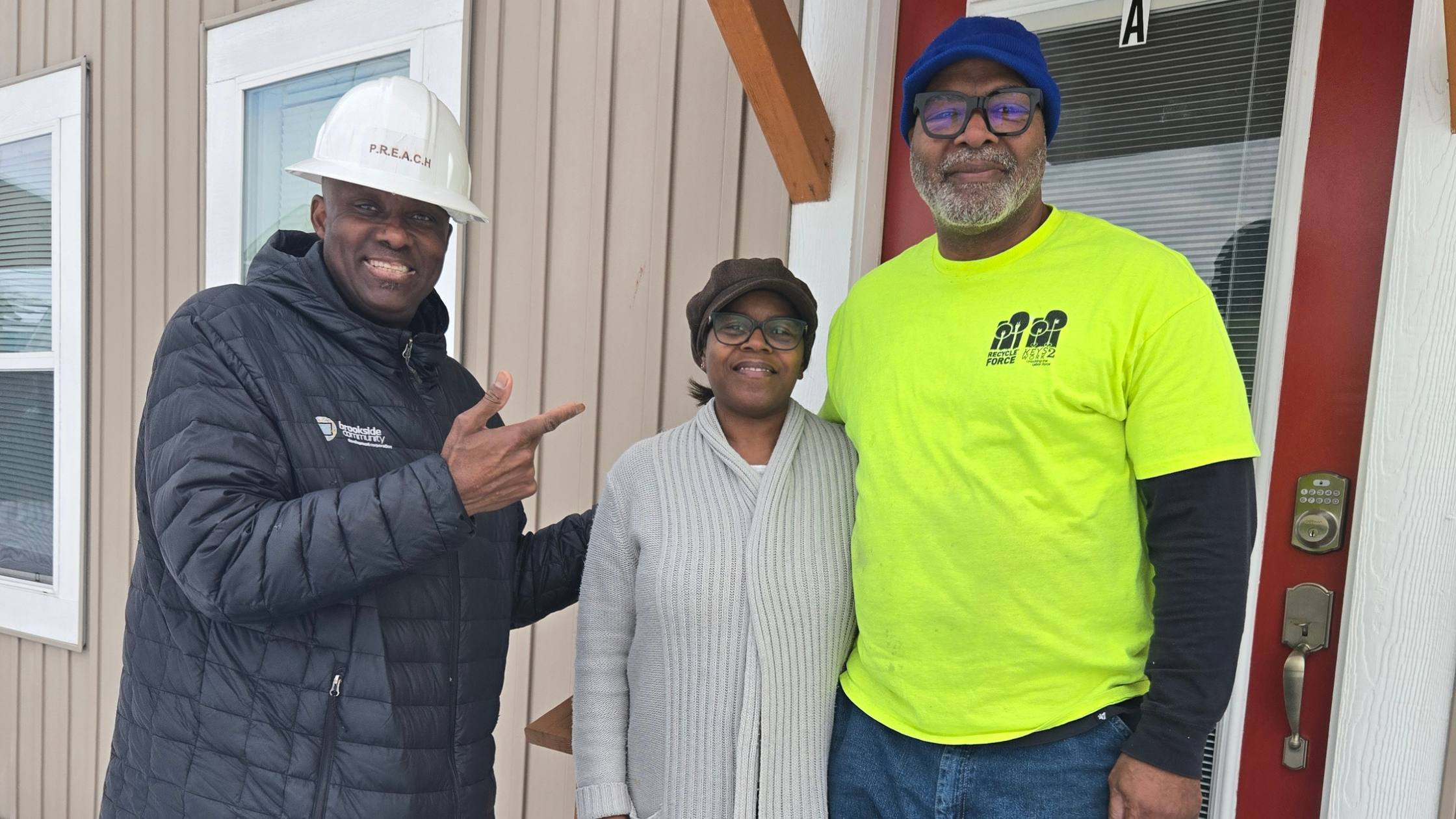
When RecycleForce board member Charles “Preach” Neal learned about Mr. Brewer’s housing situation, he stepped in not just to help, but to advocate. He worked closely with Mr. Brewer and his wife, guiding them through the process and reminding them that their future was still worth fighting for. He knew it would take more than hope, it would take action, advocacy, and community.
At the same time, Erin Anderson, a local property manager, received a call that would change everything.
“I was reached out to about a participant who was having a hard time finding housing,” Anderson said. “Where they were being placed just wasn’t safe or suitable.”
Instead of turning away, she chose to lean in. After speaking with Mr. Brewer and understanding his situation, Anderson offered to show him and his wife a couple of available properties. They toured two options, but it was a fully furnished one-bedroom apartment on Indianapolis’ near north side that sparked something unexpected.
“They said, ‘We really like the idea of starting fresh,’” Anderson recalled.
A Fresh Start
And just like that, a new beginning took shape. With keys in hand and a space of their own, Mr. Brewer and his wife moved into a home where they could finally be together, something that once felt out of reach. But what happened next left an even deeper impression. After receiving the deposit and first month’s rent, Anderson was met with a moment she won’t soon forget.
“She hugged me and said, ‘You have no idea what we’ve been up against…I could just cry right now.’”
Anderson paused.
“I said, ‘Please don’t, because if you cry, I’m crying with you.’”
What might seem like a simple transaction, a lease signed and a set of keys exchanged, was, in reality something much bigger. It was dignity restored, stability gained, and a couple finally able to build a life together under one roof.
“It’s easy for many of us,” Anderson reflected. “If we want to rent somewhere, we can. But for someone coming home from incarceration, it’s not that simple. And it shouldn’t be this hard.”
More Than a Mitzvah
What stands out most about RecycleForce’s work, Maurer says, is that it refuses to reduce people to their past.
“RecycleForce treats its participants as full human beings with futures, not as problems to be managed,” he said.
That approach reflects a deeper principle.
“In Judaism, we have a single word for this: tzedakah,” Maurer explained. “It is often translated as charity, but its root is tzedek—justice. The implication is that giving people the conditions to restore their own dignity is not generosity. It is what we owe each other. It is what is just.”
A Second Chance Can Change Everything
For Preach, this story is about more than housing, it’s about recognizing human dignity.
“We’re humanizing people,” he said. “We’re recognizing their worth, their value. And when we do that, we begin to break cycles.”
He points to three essential needs for anyone returning home: a job, a place to live, and a community willing to receive them.
“96% of people who go to prison are coming back,” he said. “The question is—what are they coming back to?”
For Mr. Brewer, the answer is finally changing. He’s not only thriving at RecycleForce, but stepping into leadership among his peers. He’s reconnecting with community through Brookside Community Church. And perhaps most importantly, he’s building a stable life alongside his wife, something that once felt nearly impossible.
“This is someone who understands hard work, discipline, and commitment,” Preach said. “We believe he’s going to be a star.”
Maurer offers a final reflection for the broader community:
“The person you are hesitant to hire may be someone whose journey through failure and accountability has made them more capable of loyalty and genuine contribution than anyone who has never had to fight their way back.”
And the impact reaches far beyond one individual. “The Talmud teaches us that saving a single life is like saving an entire world.”
From Shoes to Something Greater
Stories like Mr. Brewer’s don’t happen in isolation. They happen when people choose to see beyond a past and invest in a future. When landlords take a chance. When community members step in. When organizations like RecycleForce create pathways, not just programs.
What started with a simple need (a pair of shoes) has become something far greater.
A home, a second chance, and a reminder that when a community comes together, real change is possible. And a reminder that when communities come together across backgrounds, across experiences, and across histories, we don’t just change one life. We help rebuild entire worlds.